


 |
| Copyright Jack Penford Baker |
 |
| Copyright Jack Penford Baker |
 |
| Copyright Jack Penford Baker |
 |
| Copyright Jack Penford Baker |
 |
| Copyright Jack Penford Baker |
 |
| Copyright Jack Penford Baker |
 |
| Copyright Jack Penford Baker |
 |
| Copyright Jack Penford Baker |
 |
| Image Copyright to UofM |
 |
| Image Copyright of MMU |


 |
| Students will be dressed in home made Get Over It! attire. |
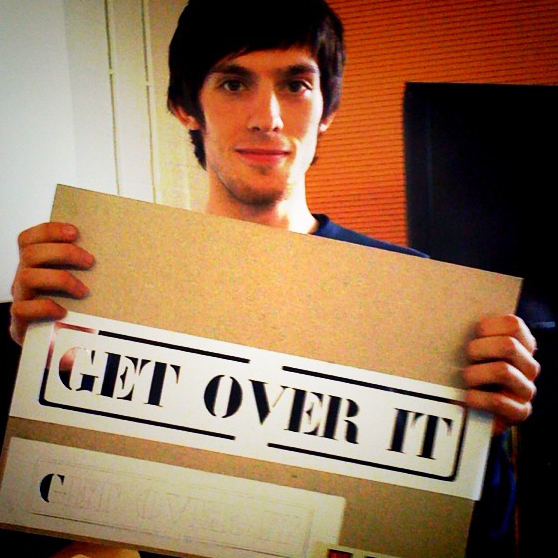 |
| Student Jack O'Reilly shows off the T-Shirt stencil. |
Eamonnm Caniffe, a lecturer at the Manchester School of Architecture, has politely offered to provide an article to feature on what hopefully will become a recurring section of guest bloggers.
A prolific writer and lecturer, he currently runs the Architecture Research Centre and the MA in Architecture + Urbanism at the Manchester School of Architecture. His work revolves around the urban environment, having published books that cover a wide spectrum of architectural theory, including the Politics of the Piazza: the History and Meaning of the Italian Square and Ethic: Design in the Contemporary City. He frequently publishes his own musings on his blog; Guttae and his lecture series at university are always full of fanatical discussions.
A paper delivered at SPACE IS LUXURY the 24th AESOP (Association of European Schools of Planning) Conference Helsinki 7-10 July 2010
Periodically Manchester has been the subject of planning studies that have sought to provide an improved urban environment. These have reflected changes in architectural fashion, and historically have comprised proposals for the central civic areas, slum clearance leading to comprehensive redevelopment, and most recently re-urbanisation. Because of their size and the only partial and haphazard completion of these public strategies, as well as the fluctuating fortunes of commercial development, a fragmentary urban environment has been the result.
The current accommodation between public and private interests presented a series of development opportunities, although the projects that have been implemented suggest a certain level of enduring banality. The image of the industrial city that survived and has been promoted is now complemented by the elaborately patterned facades which conceal the shells of unoccupied spaces. This sharp division between utility and decoration continues to haunt architectural and urban debates, and Manchester’s present state is entirely typical of many British cities, despite the oft-repeated claims to primacy or uniqueness.

On July 5 2009 central Manchester was the site of a performance piece by the artist Jeremy Deller entitled Procession which featured a series of surprising tableaux. While the commissioning of an art event might not have the authentic resonance of a traditional urban ritual (such as the Roman Triumph, or Holy Week in Seville), this populist production for the Manchester International Festival had much to gladden the jaded urbanist’s heart. It had a Roman road, Deansgate, to process along between the castrum origins and the later medieval core. It had an eager and appreciative crowd gathered either side of the route. And it had a series of familiar and unfamiliar sections evoking some mythic scenarios. The Rose Queens of Manchester’s largely defunct Whit Walks traditions were joined by a robust outing from The Ramblers. The all-singing, all-dancing, mock-baroque of ‘The Adoration of the Chip’ contrasted with a fleet of hearses commemorating closed but legendary nightclubs, from The Hacienda to Rotters. The Big Issue Sellers and Unrepentant Smokers (followed by a sobering health warning) provided the smudge of ‘gritty northern realism’ but the procession concluded with the crowd gleefully following down Deansgate. The pied pipers were, alas, not the Shree Swaminarayan Gadi Pipe Band from Bolton, but the equally delightful Caribbean band Steel Harmony, sweetly syncopating the works of The Buzzcocks and Joy Division.
Perhaps the performance of Procession did not have the transcendent qualities of a great urban narrative reenactment, but it said more about the notions of civic pride and place than the banal receptacles of spectacular consumption which form Manchester’s recent cosmetically enhanced cityscape. Early in the sequence a truck mocked up as a textile mill complete with a smoking chimney brought the built environment of the city into the spectators’ consciousness, the ur-form of industrial space drawn as a belching icon through an apparently very different context. In particular two recent developments, New Islington and Spinningfields, highlight the superficiality of the strategies that typify recent planning decisions aimed at transforming the image of the city.
Outside the city centre, in the rather desolate doughnut of inner city margins, more public investment is evident through the attention focused on problematic inner city estates created in the wave of post Second World War slum clearance. As the latest demonstration of this policy, the redevelopment of the Cardroom Estate in East Manchester is intended to remedy the scars of industrial squalour and post-industrial decline. Urban Splash were commissioned as lead developer to deliver a re-invigorated community, with a mixture of social and private housing, between the booming city centre and the Eastlands development initiated on the back of the 2002 Commonwealth Games. The masterplan produced by Will Alsop in that year for the rebranded ‘New Islington’
promised a bright future of ‘urban barns’, an extended waterside landscape with a new canal arm, and the trappings of twenty first century city living. The exploitation of a vivid colour palette suggested a slightly forced optimism in the face of the serious problems of the area and the general greyness of the climate. Whatever the more theatrical aspects of the Alsop masterplan the strategy of ‘fingers’ (of accommodation, of landscape and of water) was adaptable to the compartmentalisation of the plan into different packages, with different scales and housing types, and to be produced by different hands.
New Islington presents a situation where there is the attempt to accommodate both divergent ends of Manchester’s social divided spectrum. The masterplan for the area required the accommodation of the existing depleted population, and the attraction of a new aspirational class who would be prepared to endorse Alsop’s aesthetic with their cash. The area will take some years, possibly decades, to mature, but the first new developments of social housing, Islington Square by FAT Architects and Guest Street by dMFK, are occupied and Alsop’s CHIPS development of apartments is beginning to fill in the pattern of fingers of occupation specified in the masterplan. A further architectural competition, dubbed ‘Tutti frutti’, confidently invited participants to invest £200,000 for an empty plot on which to build a terraced house. Only time will tell whether this optimistic not to say economically precarious vision of the harmonious urban future will root in the previously neglected urban environment of the Cardroom Estate.
 Will Alsop’s 2002 masterplan exemplified the mediation of this strategy through the use of seductive communicative means, a narrative which suggested that a difficult reality had been overturned by an urban fiction. After substantial infrastructural works and relatively modest domestic projects by other architects were completed, this landscape of continuing urban desolation has been epitomised by the finalising of the long-awaited CHIPS apartment building, it its own way as baroque as the theatrical vision of the chip which featured in Deller’s Procession. Nothing could be further from the anodyne image of conventional urban renewal in Britain. Uncannily similar to the computer simulation produced as part of the marketing campaign, Alsop’s brightly-coloured reveals, the building’s super-graphics and the waterside location will perhaps distract the architectural tourist from the brittle quality of the building’s construction. While CHIPS exemplifies a certain degree of disengagement from its context, this distance is only a symptom of the frenetic switching between development and disillusion which has provided the backdrop to British urban regeneration.
This see-saw now moves at such a pace that forms are exhausted virtually the moment they are disseminated, diminishing the aura of the architectural and urban object, while fuelling the appetite for further novelty. However, what is most startling in the fulfillment of the masterplan is the meanness of the spaces provided for occupation in contrast to the generous provision of public open space, in sharp contrast to the overdevelopment evident in other parts of the city. The lack of construction caused by the economic downturn therefore means that a series of isolated developments will enjoy an amplitude of open space in varying degrees of completion and abandonment for some time to come. The bus stops are in place to ferry future residents, but eight years after inception one would still have to be a very optimistic pioneer to invest your hard-won mortgage in this key example of contemporary urban anomie.
Whether ambitious projects such as New Islington indicate foolhardiness or naivety, they suggest that an incremental and open-ended policy for regeneration would be less wasteful of resources and aspirations, and would produce an environment where the quality of the public realm could be utilized rather than merely decorated. The economic benefits of such a strategy might take a long time to accrue, but the indications are that such a course might result in a city that is less self-consciously alienated from its inhabitants. As has already been indicated the compromised nature of Manchester’s contemporary urban form is a product of fluctuating regeneration policies of the last quarter century. Beginning modestly with projects for conversion and reoccupation in abandoned industrial areas in response to the economic collapse of the early Thatcher years, an urban aesthetic was developed, a post-industrial interpretation of the postmodern which was specific to the city. Following the damage caused by an I.R.A. bomb in June 1996, Manchester’s regeneration accelerated to place it as a frequently cited exemplar of British urban policy, and its identification with traditional urban forms was in turn abandoned. The result has been that, in the city centre, a policy that with varied degrees of success had sought to preserve the character of the 19th century city was turned overnight, as a
result of the bomb, into a policy of "boom". Aesthetic concern for the city, in the attempt to defend the integrity of historic buildings, was deemed unrealistic and reactionary. A premium was placed on the novelty of the intervention, in illogical contrast to the sensitive preservation of industrial structures and environments that had been followed previously. Projects developed since that post-bomb period have eviscerated the urban structure of the 19th century city and replaced it with high-rise buildings in an ill-defined groundscape. However it is possible to discern that this fragmented cityscape has its origins in planning policies that have been pursued with varying degrees of vigour since the end of the Second World War.
The general situation of decline was a disease for which the 1996 IRA bomb damage was decisive in accelerating radical surgery. Whereas the planned response to decay had been to simulate traditional forms of urban growth in a condensed time scale, even more dramatic possibilities could now be considered. Allied to the commercial threat of out of town retail development, the bomb provided the opportunity for the city to reconsider itself in global terms. As a result Manchester city centre was rapidly redeveloped, and as the new skeletal concrete forms grew from the rubble there was a brief moment to remember the city's aspirations and analyse where current developments were leading. In its 1997 design guide Manchester City Council promoted a particular vision of its stewardship of the urban environment. In particular, this document focused on sustainability expressed through a diet of familiar physical criteria that were deemed to have somehow lapsed from designers' collective consciousness. A strategy was proposed which simultaneously adopted traditional patterns of urban design and projected an innovative vision of Manchester's place in the world. Of course, Manchester has long had an international reputation for commercial
pragmatism regardless of the social and urban consequences. 19th century visitors from continental Europe were shocked. De Tocqueville and Engels remarked on the disastrous social fallout of the early industrial urban experience. Despite this hellish vision, the radical industrialised space of the Manchester mill was exported to Berlin by the Prussian court architect Schinkel and transformed into the beginnings of a new urban vernacular of brick, cast iron and terracotta. More than a century and a half later these processes are reversed and Manchester has to import the latest industrialised building methods in an effort to survive as the commercial centre in the region let alone improve its position in the global economy.
The juxtaposition of these regeneration projects was promoted as part of national urban policy after the 1998 Rogers report Towards an Urban Renaissance with the remaining industrial context, the later 19th century architecture and organic urban cityscape only adding to the pathos of the simulated central business district which has most recently been created in time for the latest financial crisis.
This strategy is most evident in the Spinningfields development, sited in the area of the city that had been most directly affected by the 1945 Plan. Crown Square, a civic area of court and municipal buildings has been rebranded as a financial and retail centre by the developer Allied London. The morphological tradition of disconnected object-like structures has been revived, erasing the intervening six undistinguished decades. Key to the recent developments is the model provided by Albert Bridge House completed in 1958-59, a work of austere modernism which has always provided difficult environmental microclimate conditions for office workers and passers-by. The winds generated might now be funnelled between it and its new neighbour in the Civil Justice Centre (Denton Corker Marshall 2007), which acts as a backdrop to another product of the post-war era the peculiarly retardataire Crown Court (1962) by the city architect Leonard C. Howitt.
The architectural history of Manchester is spattered with previous attempts to create business districts which have survived to be regarded subsequently as high points in its urban heritage. The indigenous typological invention of the ‘palazzo’ warehouse formed the sober scenography to the streetscape of, for example, Princess Street in the mid nineteenth century. Scale and decoration both became more inflated by the time Whitworth Street’s canyon between terracotta facades was formed at the turn of the nineteenth and twentieth centuries. King Street, the banking district of the city until the early 1990s has a family of many generations of structures from C.R.Cockerell’s Bank of England through to Casson and Conder’s National Westminster Bank. They asserted their integrity (largely) through the articulation of their stone surfaces, rusticated in traditional forms, ribbed and tooled in the modern, occupying their plots from the vantage point provided by high ground floors. The break in this pattern was provided by Lord Esher in Pall Mall Court with its smoked glass lined public space to the rear, which represented the latest developments in business architecture and indicated the way to the present situation.
The treatment of the small number of significant examples of architectural heritage reveals the evaporation of civic values in the Spinningfields development. For example, Lloyd Evans Pritchard’s refurbishment of the original John Rylands Library building has revived the fabric, but the new planning arrangements introduced with the latest ill-advised extension (Austin Smith: Lord 2007) suck the life out of Basil Champneys’s building. While many may mistake the building’s Deansgate frontage for a church, they all recognise that it is a building of significance and quality. The new entrance in the side extension suggests nothing more than yet another banal retail space, or perhaps a failing department store. The new buildings of the area are without any sense of place, and are glumly staid, a small scale vision of the technocratic urban centre fundamentally delineated by Le Corbusier eighty years ago. They stand around the development awkwardly misaligned with each other and unconvincingly heterogenous in their exterior forms, different wrappings around the same sort of functional space. But at least they have a genuine function, unlike the public realm of the area, where the same futile decorative mentality attempts to modify the obvious meaninglessness of the space.
In confirmation of this gestural drift, the largest new civic structure of the development, the Civil Justice Centre presents a series of confusing images. The banality of the building’s organisational diagram, a frontside and a backside, a spine of circulation, presented a degree of self effacing refinement which the architects attempt to overturn by squeezing the floors out as cantilevers. As they slip into the huge structure through an embarrassment of a public entrance what are those involved in the legal process to make of this gymnastic display of potential collapse? The appearance of disintegration is effected to provide the judges with a dining room with a spectacular view, but also a largely enclosed major court room. Such reassuringly utilitarian messages are commonplace in Manchester architecture, so the lack of sentimentality could be thought of as a demonstration of the genius loci of the city, or an appropriation of vacant disregard for reality. Essentially the building represents nothing more than a monument to the bureaucracy of family breakdown, which despite its very expensive efforts is relatively hard to distinguish from the banks and accountancy firms that litter Spinningfields.
 The marketing strategy of the city centre residential boom has been transferred to the commercial office sector with the attempt to produce a ‘community’ out of office workers. Not surprisingly economies of scale play their sometimes unacknowledged part. Throughout the Spinningfields development the public spaces are particularly redundant, lacking the sort of fluid changes of occupation one would witness in an authentic place. The new spaces are there to provide hierarchy to otherwise largely indistinguishable buildings, to ‘add value’ in the cost per square metre of an address on a ‘square’, over one on a ‘boulevard’, over one on an ‘avenue’. Urban space in these situations is part of the commodification of urban property rather than the provision a genuinely public realm.
Looking ahead, the new spaces created as part of the Spinningfields development are so stupendously formless they can only indicate their eventual occupation by yet more office building. Large patches of lawn suggest future development plots that might give more definition to these late manifestations of s.l.o.a.p. (space left over after planning). Lines of skater-proof benches provide rhythm of potential occupation, although hard up against the glass elevation of the Civil Justice Centre, they offer little prospect of comfort, let alone a view. In Hardman Square the enigmatic forms of polished black stone attempt to provide interest to the yawning space which opens out towards the monuments of early twentieth century Manchester, the rear and stage door of Sir Albert Richardson’s Opera House (1912) and the roofscape of Joseph Sunlight’s Sunlight House (1932). This public space complements the essentially private functions of the work place, while the cultural and civic monuments, the Rylands Library, the Crown Court and (perhaps thankfully) the new Magistrates’ Court struggle for a public presence against their newer, attention seeking, commercial neighbours, with their V-sign columns, confusingly suppressed entrances, ineffective signage, and the visual detritus of internal occupation.
The package of aspirations that the occupant is offered by Spinningfields represents a particularly impoverished form of urbanism. Attention lights on the palette of accumulated brands precisely because the physical environment (buildings and spaces) in which they are contained is so banal and devoid of consolation. While the scholastic gloom of Basil Champneys’s John Rylands Library (1899) perhaps offers no direct model for contemporary emulation, the quality of its construction and longevity of its use and occupation present a sharp riposte to the disposable buildings and spaces of today. This lamentable situation is exemplified by the latest miserable product of retail / office space, 2 Spinningfields Square, which has appeared adjacent to the “last significant flowering of Gothic in the city”. Individuality is reduced to the illumination of corporate logos and the complexity provided by a gratuitous and hard to occupy plan form, produced by its prismatic form as a reductio ad absurdam. Nothing more underlines the inappropriateness of this particular commercial bauble to the present economic circumstances than the promotional CGI film where two improbably refined financial services employees divert themselves with a few minutes of retail therapy before the inevitable arrival of their redundancy notices.
 The perhaps equally inevitable arrival of economic stagnation brings a sense of closure to these recent developments. Praised as innovations they have introduced often dramatic change into the Mancunian cityscape, but the incompleteness of their resolution, and the fragmentary discontinuity their thwarted plans produce is firmly rooted in an urban tradition identified by Roland Nicholas well over sixty years ago, where
‘the spirit of materialism and indifference to beauty … has been mainly responsible for the undistinguished appearance of the present city centre.’
References:
Eamonn Canniffe and Tom Jefferies, (1999). Manchester Architecture Guide, Manchester Metropolitan University Faculty of Art and Design.
Eamonn Canniffe, (2006). Urban Ethic: Design in the Contemporary City, London and New York, Routledge.
Eamonn Canniffe, (2000). Tabula Rasa as Tradition: Rebuilding Manchester Again, Traditional Dwellings and Settlements Review, Volume 131, 26-33.
Eamonn Canniffe and Sally Stone, (2007). Building Study: de Metz Forbes Knight’s Guest Street Scheme in New Islington, Manchester, The Architects’ Journal, No 18 Vol 225, 25-37.
Eamonn Canniffe, (2007). Exploring the fragments of a discontinuous city: Post-Regeneration Manchester ‘Planning for the risk society’ Association of European Schools of Planning XXI Naples July 2007.
Eamonn Canniffe, (2008). Tradition and Change in Post-Regeneration Manchester, Traditional Dwellings and Settlements Review, Volume 203.

Look Up Manchester seeks to relay architectural news to the masses, but things are to change. We will set ourselves free from the containment of architecture and look to bring you the news of design and architecture in and around architecture. As with the likes of Zaha Hadid and her fashion orientated designs, or even Mies Van Der Rohe’s Barcelona chair, architects have always sat themselves right in the middle of the world of design, it only felt natural for us to do the same.
This week see’s 2 events in Manchester capitalising on the ever growing art and design culture scene. First is the opening of a new exhibition in the EASA HQ named 36 EXP. The second is a retrospective look at Puma’s design history, cleverly housed in a single van that transformers into an outdoor showroom.

36 EXP describes itself as a photographic exhibition involving 36 artists and 36 contact sheets. Taking the original properties of an original film that takes 36 exposures, artists were invited to submit their personal response to an entire film of photographs. The step back to older techniques offered the entrants to mix an amalgamation of modern ideas with old process.
The work on show expresses a missed art, the softness of old film is heavily underestimated in todays digitally centered world. Film’s use is decaying more as each day passes, cinemas are beginning to retract 35mm projectors in favour of modern digital projectors, and the art of the projectionist is almost extinct. 36 EXP will hopefully show the contrast of film to the sharp unnatural digital alternative through the artists’s carefully created exhibits.
The exhibition opens on the 30th of September at 6:30pm till 9:00pm and looks to be an interesting display of photographs. Find out more at http://36exp.visualsociety.com/.
PUMA are currently in Manchester with their REWIND FORWARD van. The scheme looks to showcase an archive of designs in a contemporary way. Once in location the van disassembles then reassembles as a multifunctional “Pop-Out” shop. Included within the space once erected are seating, storage and TV screens. Music is to be played to passers by and there will also be a chance to win archive products of Puma.

The van will be present at the NCP on Bloom Street between the 28th and 29th of September. Find out more at facebook.com/puma.


